Metallica vs. Napster: The Day Rock Ate Itself
- 10 minutes read - 2049 wordsI wrote recently about what Metallica meant to me — the album, the musicians, what it felt like to be a skinny kid hearing “Blackened” for the first time. The coolest band on the planet.
So how did they become a punchline?
“Napster versus Metallica” was more than a lawsuit. It felt like a moment where skinny thrashers in jean jackets became the homeowners association of Marin County, parodies of themselves. And in the midst of it, the technological generation — my tribe — laughed and snickered: the old men just didn’t get it. “Information wants to be free.” As someone who was still smarting at being abused by the record industry it felt like justice for us.
But there was a cost. They were right — Metallica was right, and especially Lars Ulrich was right. But they bungled the optics: he needed a personal adviser and a tech adviser who worked for him, not the labels; he needed perspective; he needed to take a breath.
Great art is work and takes time. Artists deserve to buy homes, and food, and braces, and go on vacation. And that childish entitlement to “free shit online” led to the current internet ad model. It enabled the walled gardens of MySpace, Facebook, and Twitter; ultimately helped bring about the death of journalism; and built the communications organ that enabled grievance-filled echo chambers to elect Donald Trump — twice.
The Setup
By 1999, Metallica were one of the biggest bands on the planet, multimillionaires with mansions, lawyers on retainer, and a back catalog worth tens of millions of dollars sitting in a vault. These were not struggling artists. “Damage Inc.” was also now “Metallica Inc.” supporting a staggering road show, roadies, service people, techs, lights, and pyro. After the Black album, they weren’t my closet love anymore; they were, as photographer Ross Haflin once said on “VH1 Behind the Music,” the “Led Zeppelin of this generation.” But by that time I was firmly on to my indie and Texas Roots phase: Wilco, Emmylou/Doug Sahm/Gram Parsons, Radiohead’s “OK, Computer” era, Lucinda Williams, the Sundays, Sun-era Johnny Cash, and Tool.
Into this world came Napster, a peer-to-peer file sharing service launched in 1999 by 18-year-old Shawn Fanning. It was crude, it was revolutionary, and it was electrifying to anyone with a dial-up connection and a patience for slow downloads. And that last part I didn’t even have to deal with; I had a broadband cable modem. For high-speed folks, it was a ridiculously sweet era.
What Napster Actually Was (To Normal People)
To understand the fury Napster inspired in the industry, you have to understand how savagely the music industry had been robbing people for years.
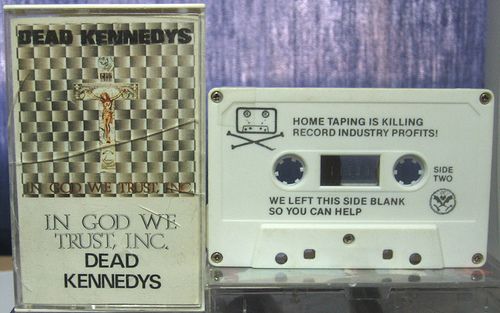
Dead Kennedys let it be know whose side they were on
A CD in 1999 cost $18–$22…for an album with maybe two good songs on it. A great album would have 4-8. A masterpiece would be solid on every song.
For early internet adopters, the tech-curious, the college students, the bedroom coders, Napster felt less like piracy and more like justice (…for all?). It was a distributed, decentralized middle finger to an industry that had spent a decade treating consumers with contempt. You could search for any song, click download, and minutes later (on a good connection) you had it.
And for those who’ve never known a Pandora- or Spotify-free life, everything we like about discoverability was there too. And did I mention it was free?
Metallica Pull the Trigger
In April 2000, Metallica filed suit against Napster, claiming copyright infringement and racketeering under the RICO statute, a law originally designed to prosecute the Mafia. They also sued three universities (USC, Indiana University, and Yale) for providing the bandwidth that students used to share files.
Then came a move that proved harder to recover from.
Metallica hired a firm to trawl Napster and document every username sharing their music. They arrived at Napster’s offices with 13 boxes of paper containing the names of 335,435 individual users, and formally demanded they all be banned. Not sued—not yet—but named, documented, and purged.
The optics were poor: a band worth hundreds of millions of dollars, pursuing individual users for downloading a lossy mp3 of their music.
Lars Ulrich and the Congressional Testimony
Lars became the face of the campaign.
His Congressional testimony in July 2000 was the most visible moment. Lars sat before the Senate Judiciary Committee and argued that Napster was stealing from artists. He described file sharing as having his “house burglarized.“1 He talked about artistic control and the sanctity of the album as a format.
All of this might have landed differently coming from, say, earnest indie darling and glorious emotional flame-out Cat Power. Coming from the drummer of Metallica, a man whose art collection alone was valued at over $10 million (he auctioned pieces at Sotheby’s in 2002), it did not land well. Lars was accused of “snitching” or “targeting fans.” I recall a website called “paylars.com” which was designed for people to send pocket change to Lars so the multi-millionaire could sleep securely at night. We imagined Lars getting a few hundred pennies on his doorstep and waking up to what a stingy tool he was being.
Message boards erupted. The mockery was substantial. Lars was not wrong on the narrow legal point: Napster was distributing his music without permission. But he was wrong on the cultural read. He seemed genuinely baffled that people weren’t on his side; in interviews, defensive and combative.
On top of that, the music industry was very much due for a wake-up call, and Lars made himself its face and looked like a quisling or a toady.
It’s worth remembering that early internet culture had a strong anti-corporate, decentralist streak — this was before the influencer, the “collab,” the personal brand. Slashdot, the dominant tech news forum of the era, treated the Metallica lawsuit with open contempt. Fans burned Metallica CDs. Radio stations reported people calling in to have Metallica songs removed from rotation. The band became, for the first generation of internet natives, a symbol of an artist defending the industry instead of defending his fans. Savviness about fans would reach its flower with Lady Gaga or Taylor Swift and their careful curating of their armies.
The tragedy was real: Metallica had famously fought for creative control, had resisted label pressure on their records, had built their following the old-fashioned way — through relentless touring. Their anti-corporate credentials had once been genuine. They released an album called “Metal Up Your Ass,” fercryinoutloud.
None of that history translated once the lawsuit was filed. The gap between the band’s self-image and its actions was too wide.
But the master’s house will not be rent apart by the master’s tools. No publicist was going to turn Lars back on the music biz hand that fed. And Lars probably got some bad (or no?) tech advice. Ultimately, it would take Pixar mogul and tech guru Steve Jobs, as well as a bloodletting of profit loss, to say what Lars could have privately said in a board room to label staff: “We’re on the wrong side of history and technology. Let’s start Metallica streaming.”
Unfortunately, the Fabian tactics of choice were lawsuits and deaf ears instead of innovation.2 And the price of that was handing it to Jobs and iTunes.
Checkmate
Was there anything Lars could have said to avoid being the internet’s punching bag?
No, I don’t think so. With the toothpaste stomped out of the tube, his audience needed to be the record companies. He’d have needed to point out that consumers were sick of getting fleeced; he’d have needed to say that casual discovery was huge on Napster and was winning millions of fans; he’d have needed to point out the convenience of it; he’d have needed to foresee the death of record shops and the elimination of CD racks at wholesale stores. He’d have needed to see the future and a far-off idea called Spotify. He’d have needed to imagine a portable music player that didn’t need record shops. It was too far to expect anyone, even the canny Lars, to see.
And he’d have needed to say it to comfortable MBAs in suits. By this point in Metallica’s career, the suits were his boys. You can’t expect a man to see uncomfortable truths about his living situation when said situation depends on his not seeing it.
Lastly, we are all blinded by the constraints of our times: the seeds of what comes next are usually visible only in hindsight, rarely in the moment. Lars railed against the change which he saw taking his due in terms he understood (lawsuits).
The Thing Lars Actually Got Right
Lars was not wrong about the principle. Artistic work is hard.
Without a profit motive record companies stopped listening for something new and used algorithms and electronic production to target guaranteed wins. Chances were not taken. Our ears are more bored.
And with profits being slimmed, the instinct to pick up a guitar and hang out with friends became trading tracks over Dropbox. It’s still art, but it’s missing the smell of motor oil and Ernie Ball guitar strings.
And yes, art always finds a way. Napster opened the way for home-production. Ableton opened possibilities for poorer / poorly-located artists to reach around the globe. And I’m in awe of what Switch Angel does on her YouTube channel.
A different man, in a different room, might have said something like:
What does it mean when the best parts of life: jamming, shows, storytelling are free; that is, literally, value-less? To whom will we cede the money? We’re going to want movies and music, and journalism, and encyclopedias, and books because we’re human. But to whom will we give the money when those things are “free”? And a world where music is “free,” movies are “free,” journalism is “free” means that the money for overhead comes from somewhere else: ads. We’re going to trade one master (my bosses at the record label) for new masters: ad companies and ad resellers. It’s the drug-pusher model: it’s all free until the addiction sets in and then you’re going to yearn for how bad it was before because it’s worse later.
What “free” actually built over the following two decades was the advertising-driven attention economy. The prophet Lars I just imagined might have told us. Journalism didn’t get liberated; it got hollowed out chasing pageviews and audience capture to replace the subscription revenue that evaporated. Musicians didn’t get freed from label exploitation: they got Spotify, where a million streams might net enough to cover a car payment. The work that requires time, patience, and funded independence got hit hardest.
With all the costs externalized it doesn’t bite like a $22 album. But it may be costing us much, much more.
The Aftermath
Napster was ultimately shut down in 2001 after losing in the Ninth Circuit Court of Appeals. It was a legal victory for the labels and for Metallica, and a cultural one they never fully recovered from. Gnutella, Kazaa, Limewire, and a dozen other services sprang up in Napster’s place, decentralized enough to be nearly impossible to sue.
Lars has, to his credit, softened his position considerably over the years, acknowledging in later interviews that the band may have misjudged the cultural moment. Apple provided the real solution: cheap, legal, convenient digital music at 99 cents a song, doing more to end piracy than every lawsuit combined, simply by making the legal option easier than the illegal one. And then they, in turn, got sharked by another price-gutter, Spotify.
The damage (inc.) to Metallica’s reputation among a generation of music fans was permanent and self-inflicted.
…But damn I still love “…And Justice for All” and “Master of Puppets.”
Footnotes
- Lars Ulrich testimony before the U.S. Senate Judiciary Committee, “Music on the Internet: Is There an Upside to Downloading?”, July 11, 2000. Congressional Record, public testimony.
- The reflex to lawyer-up rather than innovate is not unique to the music industry. It’s the first move of comfortable incumbents everywhere — see also the RIAA’s broader campaign against individual file-sharers, the film industry’s early response to the VCR, etc. The pattern is consistent: litigation buys time, but it doesn’t buy the future.