Hyperion
Dan Simmons
- 20 minutes read - 4142 wordsAuthor: Dan Simmons
Rating: ★★★★★
Some time in 1992, during my sophomore year of high school, Westwood released their landmark real-time simulator video game Dune II. After many hours in-game, I wanted to get into the lore of the universe.
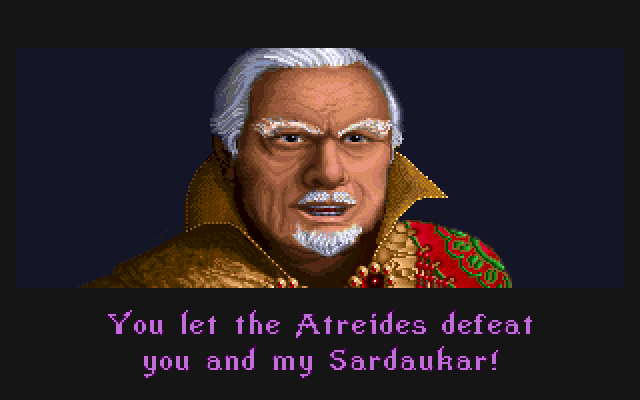
…to say nothing of my GPA
I picked up a tattered copy of Frank Herbert’s Dune at the library.
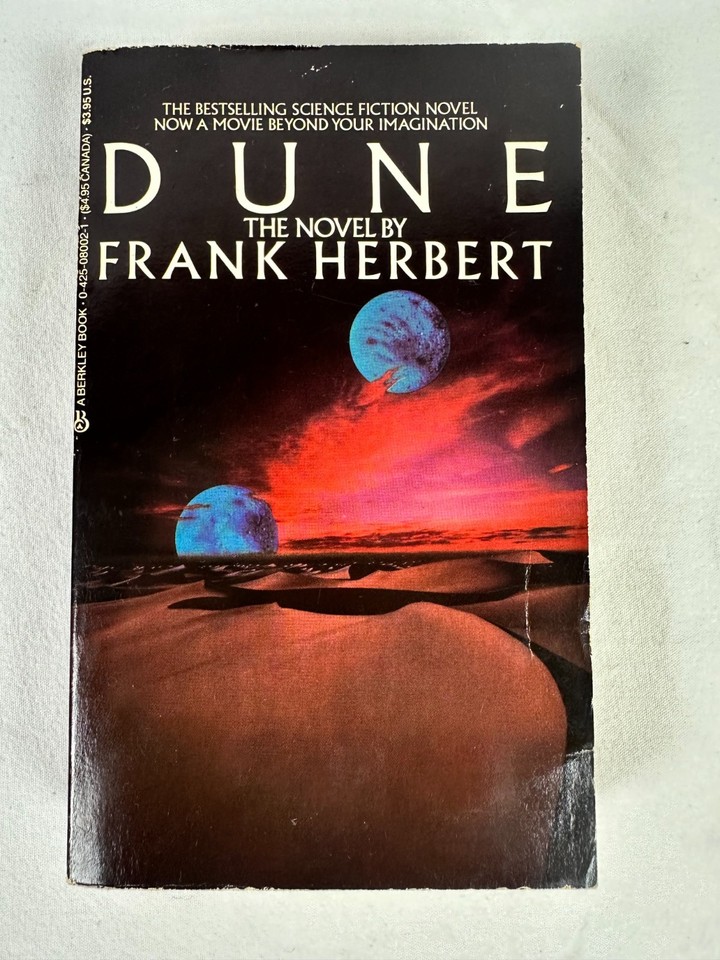
Whoa.
It was the promotional paperback tied to the 1984 film complete with stills of Kyle MacLachlan and Sting and cocaine on the back.
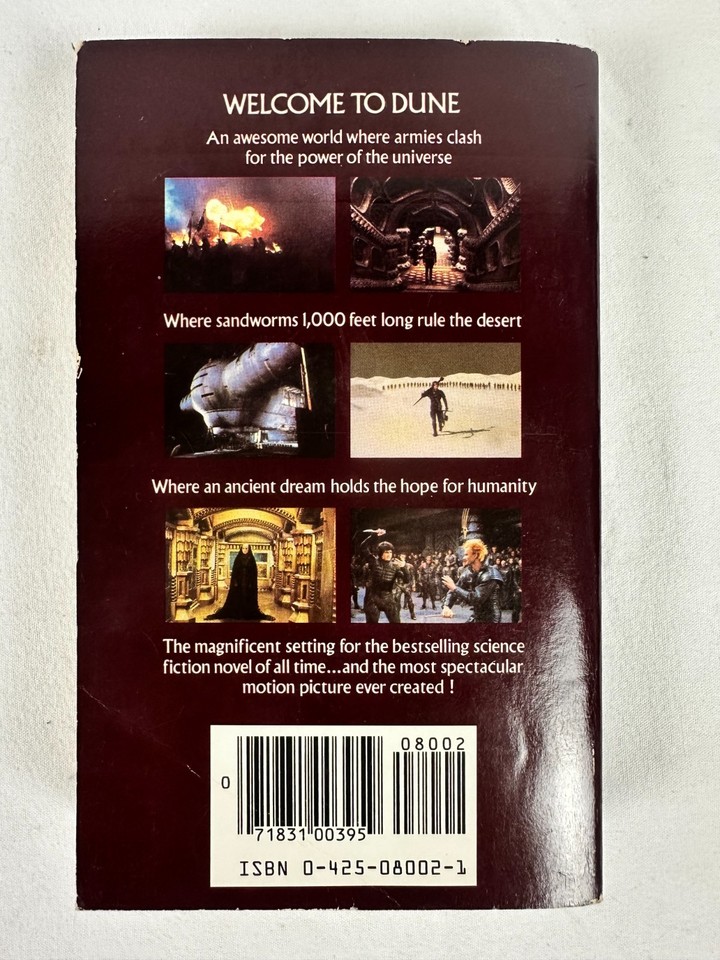
Tantalizing!
A few hundred pages in, I was convinced: this was my favorite science-fiction book ever, and probably always would be.
Challengers came and went. Foundation fizzles quickly after the first book and Asimov never could write a believable woman or believable sex. And The Martian Chronicles are like poetry or epigrams, they’re too sad or too beautiful or too perfect for this world. They’re not meant to be your favorite sci-fi book. Recent entrants like The Southern Reach were too confused or undisciplined to be my favorite. It remained Dune — for thirty years, no challenger came close.
Hyperion is the first book that has made me genuinely wonder.
I might have resisted the narrative framing: a sci-fi Canterbury Tales with pilgrims trading stories on their way through ghastly circumstance. I might have bristled at the cover — a nightmare creature made entirely of blades, looming over a pastoral landscape. I might have discounted the possibility that a book with those strikes against it could be this good. But after reading it, those elements all contribute to Dan Simmons’s majestic storytelling.
Note: Simmons died recently. I disagree with his social media posts of his last several years. Some of them I cannot square with this particular book. But I am not evaluating such in this post.
The Canterbury Tales Conceit: Wrong to Dismiss It
I almost did not read this book. The structure of pilgrims each recounting a story on their way to a shrine sounded contrived. It felt like a gimmick to get people to say “it’s a Canterbury tales in space!” and sell copies.
I was completely wrong.
The frame is far richer than Chaucer’s, and every pilgrim’s tale is in service of a single larger meta-narrative. More importantly, Simmons uses the conceit to do something genuinely impressive: each tale is written in a different voice and a different literary register. He is not writing one genre of fiction; he is working in several simultaneously. Lastly it helps avoid the exposition-heavy lopsidedness that happens so often in sci-fi where a whole biology/society/economic system has to be laid out before you can get to the narrative proper (see Dune movie).
The first tale, the priest’s tale, opens with the grain of the familiar. On a missionary venture, the last emissaries of a dying Catholic Church are dispatched to the isolated, indigenous humanoids who survived Hyperion’s first seeding. But to the priest’s great surprise, the creatures have already found the faith of the Cross. Imagine his elation, imagine the cries of “Hosanna!”
Then Simmons turns it. What the priest finds, and what we come to understand at a visceral level, is the body horror that orthodox Christianity has always carried inside it, glossed over by centuries of iconography and comfortable doctrine. A man died and came back. What does that actually mean? What does it feel like from the inside? What would it mean to have eternal life welded into you? Simmons answers that question with clinical precision:
the nematodes terminate in the amygdala and other basal ganglia in each cerebral hemisphere. My temperature, metabolism, and lymphocyte level are normal. There has been no invasion of foreign tissue. According to the scanner, the nematode filaments are the result of extensive but simple metastasis. According to the scanner, the cruciform itself is composed of familiar tissue… the DNA is mine.
It is, perhaps, a man of the cloth’s voyage into the Heart of Darkness.
By the end of the first vignette it is clear that Simmons’s Canterbury conceit is not a clever structural device for book jacket copy. It is a weapon — one he uses to send you somewhere that looks familiar, then force a genuine reckoning with what we actually believe.
The soldier’s tale is perhaps the flattest of the vignettes, but it earns its place. Think Starship Troopers crossed with something Outlanderesque — techno-fascist military expeditionism tangled up with genuine romance. What it proves, if nothing else, is that Simmons can write lust as credibly as he writes war — God knows Herbert, like Asimov, couldn’t write women or sex.
And, almost incidentally in the soldier’s tale: in the same way that Herbert never stopped the flow of the spice story to announce that humanity had only just escaped the yoke of the machines, Simmons lets you arrive, quietly, at the realization that humanity in this world has chosen to yoke itself to them. The machine Core trains the soldiers, the machine Core controls the farcasters that stitch civilization across space, and the machine Core may have the ability to manipulate human hearts.
The scholar (Sol Weintraub’s) tale is in an Ondaatje-like register; the relationships and characterizations are the point. The Shrike haunts the Time Tombs, structures that move backwards through time, and Sol’s daughter Rachel has been touched by them: she ages in reverse, forgetting day by day, the horror accumulating not in what happens but in what disappears in an “Awakenings” or “Charly-like” tale of sorrow. It is a nightmare rarely conceived of by any parent, but one that every parent would shriek away from. The line that lands hardest is not a speech or a reckoning — it is Sarai, to her husband Sol: “It’s not fair.”
The detective’s tale opens like noir, and it feels as comfortable as Sam Spade — except that Sam is now a woman, faster and stronger and more brutal, owing to a childhood on a planet with stronger-than-Earth gravity. Once again: a human story, with science fiction flourishes.
Then the genre shifts. Noir gives way to romance — an unlikely, genuinely moving love story with washes of Merchant-Ivory gauze — and then to something else entirely: cyberpunk. Hyperion was published but five years after Neuromancer, and Simmons had clearly ingested the whole of William Gibson such that he was able to write about dataspheres and “ice” and console cowboys as if he had invented the genre. In fact, Simmons’ description of cyberspace heist frankly exceeds Gibson’s in terms of clarity.
And then the closing arc arrives. First, a beautiful mystical meditation on identity and replication worthy of “Blade Runner” and then a gearing up for war that recalls anime or “The Matrix’s” final act. And then back to a love story, a lover carrying the body of their beloved on a Pilgrim’s Progress through a war zone, up a stair, into a shrine, and then into the mystical embrace of prophecy and fate.
I am going to consciously skip the poet’s tale and the consul’s tale. If the four above have not sold you on the majesty of Simmons’s approach, nothing I write here will.
The Shrike
The cover makes you think it’s a simple bogeyman. It isn’t.
An analogy: put a vial of spice or a spice harvester on the cover of Dune. Those elements aren’t the story of the Great Houses and Arrakis, but they drive it. The Shrike is the same kind of presence. It is a focusing point, a placeholder for something much larger.
What the Shrike is, I don’t yet know. But the Shrike resists the murder-robot-on-a-rampage reading the cover invites. At various points it seems merciful. Curious. Inscrutable. Incomprehensibly death-obsessed. And then merciful again. Whatever it stands for, it is a vessel for a powerful realization.
Do not let it put you off. It is not what it looks like.
Why Hyperion Displaces Dune
Hyperion Builds Through Immersion, Not Exposition
Simmons does something Dune does to a lesser degree. The story explains its world without stopping for expository devices. Dune accomplishes this to a small degree e.g. we don’t stop the world and have the Butlerian Jihad explained. However, there are multiple times when ham-handed or barely-concealed expository devices are deployed. Consider the monologues from the Reverend Mother Gaius, the lectures from Kynes, or the chapter-opening histories of Irulan. Those are not natural. You can feel Herbert cheating to get those concepts on the table.
In Hyperion we are never given a recap. We simply come to understand, across hundreds of pages, the cultural weight and shadow of what came before.
The TechnoCore’s dream-simulation enters not through an authorial aside but through a soldier’s bribed expert:
The OCS:HTN was part of the Worldweb All Thing, the real-time network which governed Hegemony politics, fed information…and had evolved a form of autonomy and consciousness all its own.
“The HTN stuff doesn’t simulate,” whined Cadet Radinski, “it dreams, dreams with the best historical accuracy in the Web – way beyond the sum of its parts ‘cause it plugs in holistic insight as well as facts - and when it dreams, it lets us dream with it.”
The Ousters’ significance arrives the same way – not as alien sociology but as a character’s dawning reckoning:
…the Ousters have done what the Web humanity has not done in the past millennia: evolved. While we live in the derivative cultures, pale reflections of Old Earth life, the Ousters have explored new dimensions of aesthetics and ethics and biosciences and art and all the things that must change and grow to reflect the human soul. // Barbarians, we call them, while all the while we timidly cling to our Web like Visigoths crouching in the ruins of Rome’s faded glory and proclaim ourselves civilized.
Hyperion Has Humanity at Its Heart
Dune is a masterwork, but it is a cold one. Herbert’s universe is populated by scheming interstellar space sociopaths. By the later books, you feel like the last person with a functioning emotional cortex in the known universe. There is grandeur, but very little warmth. Honestly, I have a hard time believing that. Will there ever be a day where humans don’t yearn for touch, for desire, for warmth? I find it hard to believe. Maybe it’s the lingering damage of having freshly escaped the Machines’ yoke, but why is everyone so bloodlessly clinical?
Hyperion feels like a human universe. There is emotion, genuine love, genuine tragedy, genuine beauty. In Simmons’ world the humans are still human even as they ponder and attempt to survive a galactic ecosystem as complex and politically fraught as Dune’s. Simmons makes room for the finer things, for the small and tender moments between people; there’s room for poetry, fashion, and parenting:
Siri’s voice had grown even more beautiful with age. There is a fullness and calmness there which can come only from knowing pain.
His characters are not just pieces on a board; they bleed — and not just after meeting the Shrike:
“That may be correct,” said Colonel Feldman Kassad, “but however they may try to use us all as pawns, we must attempt to choose our own actions.”
The vignette structure deserves some credit for this. It pushed Simmons harder than a conventional novel would have. By writing small, self-standing stories whose characterization had to be full, their motivations intelligible, Simmons wound up with a richer world. Herbert could use cryptic poetry and messianic prophecy as scaffolding; Simmons had to earn each tale on its own terms, in its own register.
There is also a structural honesty in Hyperion that Dune eventually loses. The story of an interstellar Messiah requires an enormous amount of contrivance to function — bloodlines, prophecy, spice, the whole apparatus of destiny. It asks you to believe that the universe has arranged itself around one man. Isn’t that comforting — even Herbert himself thought so! Hyperion asks us to sit in this discomfort: mankind labors under the grinding millstone of inscrutable fortune, as it always has, and there are many forces quite beyond our ken that influence it.
Hyperion is a story that does not need magic to land. It just needs to be true.
{
  "title": "Hyperion",
  "author": "Dan Simmons",
  "highlightCount": 43,
  "noteCount": 0,
  "annotations": [
    {
      "highlight": "Was it so dark a sin to interpret such ambiguous data in a way which could have meant the resurgence of Christianity in our lifetime?",
      "location": 37
    },
    {
      "highlight": "Yes, it was. But not, I think, because of the sin of tampering with the data, but the deeper sin of thinking that Christianity could be saved. The Church is dying, Edouard. And not merely our beloved branch of the Holy Tree, but all of its offshoots, vestiges, and cankers.",
      "location": 37
    },
    {
      "highlight": "It did not come off this morning. It did not come off.",
      "location": 74
    },
    {
      "highlight": "the nematodes terminate in the amygdala and other basal ganglia in each cerebral hemisphere. My temperature, metabolism, and lymphocyte level are normal. There has been no invasion of foreign tissue. According to the scanner, the nematode filaments are the result of extensive but simple metastasis. According to the scanner, the cruciform itself is composed of familiar tissue... the DNA is mine.",
      "location": 82
    },
    {
      "highlight": "Pain has become my ally, my guardian angel, my remaining link to humanity. The cruciform does not like pain. Nor do I but, like the cruciform, I am willing to use it to serve my purposes. And I will do so consciously, not instinctively, like the mass of alien tissue embedded in of me.\n\nThis thing only seeks a mindless avoidance of death by any means. I do not wish to die, but I welcome pain and death rather than an eternity of mindless life. Life is sacred -- I still hold to that as a core element of the Church's thought and teachings these past twenty-eight hundred years when life has been so cheap -- but even more sacred is the soul.",
      "location": 91
    },
    {
      "highlight": "If the Church is meant to die, it must do so -- but do so gloriously, in the full knowledge of its rebirth in Christ. It must go into the darkness, not willingly but well -- bravely and firm of faith -- like the millions who have gone before us, keeping faith with all those generations facing death in the isolated silence of death camps and nuclear fireballs and cancer wards and pogroms, going into the darkness, if not, hopefully, then prayerfully that there is some reason for it all, something worth the price of all that pain, all those sacrifices.",
      "location": 91
    },
    {
      "highlight": "But the break was a very painful one and after four days the Bikura slashed Theta's throat and took his body to the basilica. It was easier for the cruciform to resurrect his corpse, then to tolerate such pain over a long period.",
      "location": 93
    },
    {
      "highlight": "I do not know if it would be possible to inflict on oneself -- or to tolerate -- levels of nonlethal pain sufficient to drive the cruciform out completely, but I am sure of one thing: the Bikura would not allow it.",
      "location": 93
    },
    {
      "highlight": "\"He'd used a ladder to get three. maybe four meters... up on the bole of the tree. Built a sort of platform. For his feet. Broken the arrestor rods off... little more than spikes... then sharpened them. Must've used a rock to drive the long one through his feet into the bestos platform and tree.\"",
      "location": 99
    },
    {
      "highlight": "\"But .. he won. When I removed the pouch the cruciform on his chest fell away also. Just... fell right off long, bloody roots. Then the thing... the thing I'd been sure was a corpse... the man raised its head. No eyelids. Eyes baked white. Lips gone. But it looked at me and smiled. He smiled. And he died.. ...really died... there in my arms. The ten thousandth time, but real this time. He smiled at me and died.\"",
      "location": 100
    },
    {
      "highlight": "The OCS:HTN was part of the Worldweb All Thing, the real-time network which governed Hegemony politics, fed information...and had evolved a form of autonomy and consciousness all its own.",
      "location": 131
    },
    {
      "highlight": "\"The HTN stuff doesn't simulate,\" whined Cadet Radinski, the best AI expert Kassad could find and bribe to explain, \"it dreams, dreams with the best historical accuracy in the Web -- way beyond the sum of its parts 'cause it plugs in holistic insight as well as facts - and when it dreams, it lets us dream with it.\"",
      "location": 131
    },
    {
      "highlight": "...we felt no urge to join the Hegira that even then was spinning the far caster silk of the Worldweb. We were happy.",
      "location": 184
    },
    {
      "highlight": "From my earliest sense of self, I knew that I would be - should be - a poet. It was not as if I had a choice; more like the dying beauty all about breathed its last breath in me and commanded that I be doomed to play with words the rest of my days, as if in expiation for our race's thoughtless slaughter of its crib world.",
      "location": 184
    },
    {
      "highlight": "By the twentieth century, less than two percent of the people in the so-called industrialized democracies read even one book a year. And that was before the smart machines, dataspheres, and user-friendly environments. By the Hegira, ninety-eight percent of the Hegemony's population had no reason to read anything. So they didn't bother learning how to. It's worse today. There are more than a hundred billion human beings in the Worldweb and less than one percent of them bothers to hardfax any printed material, much less read a book.",
      "location": 201
    },
    {
      "highlight": "could read it. Didn't try",
      "location": 204
    },
    {
      "highlight": "I farcast to her office and threw myself into the black flow foam chair which crouched in the center of the room like a velvet panther.",
      "location": 204
    },
    {
      "highlight": "\"Yeah, well, we changed our minds [on printing far fewer copies of Silenus' book] after Transline's resident AI read it.\" I slumped lower in the flowfoam. \"Even then AI hated it?\" \"The AI loved it,\" said Tyrena. \"That's when we knew for sure that people were going to hate it.\"",
      "location": 204
    },
    {
      "highlight": "\"We did [sell one copy to the AI world],\" said Tyrena. \"One. The millions of AIs there probably real-time-shared it in the minute it came in over flatline. Interstellar copyright doesn't mean shit when you're dealing with silicon.\"",
      "location": 204
    },
    {
      "highlight": "It says something about the type of writing I had been doing that my muse could flee without my noticing.",
      "location": 207
    },
    {
      "highlight": "For those who do not write and who never have been stirred by the creative urge, talk of muses seems a figure of speech, a quaint conceit, but for those of us who live by the Word, our muses are as real and necessary as the soft clay of language which they help to sculpt.",
      "location": 207
    },
    {
      "highlight": "No true poet has been able to explain the exhilaration one feels when the mind becomes an instrument as surely as does the pen or thought processor, ordering and expressing the revelations flowing from somewhere else.",
      "location": 207
    },
    {
      "highlight": "The sound track on the disk, previously consisting of the usual banal pants, gasps, exhortations and instructions one would expect from such [sexual] activity, suddenly filled the holopit with screams - first the young man's, then Sira's.",
      "location": 221
    },
    {
      "highlight": "According to the Shrike Cult gospel that the indigenies started, the Shrike is the Lord of Pain and the Angel of Final Atonement, come from a place beyond time to announce the end of the human race. I liked that conceit.",
      "location": 223
    },
    {
      "highlight": "Of course I had summoned the Shrike. I knew that. I had summoned it by beginning my epic poem about it. In the beginning was the word. // I retitled my poem The HYperion Cantos. It was not about the planet but about the passing of the self-styled Titans called humans. It was about the unthinking hubris of a race which dared to murder its home world through sheer carelessness and then carried that dangerous arrogance to the stars, only to meet the wrath of a god which humanity had helped to sire.",
      "location": 224
    },
    {
      "highlight": "Hyperion Cantos was written with a skill I could never have attained, with a mastery I could never have gained, and sung in a voice which was not mine. The passing of humankind was my topic. The Shrike was my muse.",
      "location": 225
    },
    {
      "highlight": "The third figure did not actually appear so much as allow its presence to impinge upon my consciousness; it was as if it always had been there and King Billy and I had failed to notice it until the flames grew bright enough. Impossibly tall, four-armed, molded in chrome and cartilage, the Shrike turned its red gaze on us.",
      "location": 230
    },
    {
      "highlight": "\"My lord!\" I cried, although to King Billy or the apparition from hell I did not know then and know not now.",
      "location": 231
    },
    {
      "highlight": "\"End it!\" gasped King Billy. \"Martin, for the love of God!\"",
      "location": 232
    },
    {
      "highlight": "Anticlimax is, of course, the warp and way of things. Real life seldom structures a decent denouement.",
      "location": 232
    },
    {
      "highlight": "There were strict laws protecting card privacy but laws had a habit of being ignored or abrogated when societal push came to totalitarian shove.",
      "location": 345
    },
    {
      "highlight": "May there not be superior beings amused with any graceful, though instinctive attitude my mind may fall into, as I am entertained with the alertness of a Stoat or the anxiety of a Deer? ... By a superior being our reasonings may take the same tone - though erroneous they may be fine - This is the very thing in which consists poetry.",
      "location": 371
    },
    {
      "highlight": "[Referencing Norbert Weiner] Can God play a significant game with his own creature? Can any creator, even a limited one, play a significant game with his own creature? Humanity dealt with this inconclusively with their early AIs.",
      "location": 373
    },
    {
      "highlight": "For Poesy alone can tell her dreams, With the fine spell of words alone can save / Imagination from the sable charm / And dumb enchantment.",
      "location": 385
    },
    {
      "highlight": "\"I would have thought your Hegemony was far beyond a petroleum economy.\" // I laughed and locked the wheel in. \"Nobody gets beyond a petroleum economy. Not while there's petroleum. there. We don't burn it...But it's still essential for the production of plastics...Two hundred billion people use a lot of plastic.\"",
      "location": 451
    },
    {
      "highlight": "Siri's voice had grown even more beautiful with age. There is a fullness and calmness there which can come only from knowing pain.",
      "location": 458
    },
    {
      "highlight": "...the Ousters have done what the Web humanity has not done in the past millennia: evolved. While we live in the derivative cultures, pale reflections of Old Earth life, the Ousters have explored new dimensions of aesthetics and ethics and biosciences and art and all the things that must change and grow to reflect the human soul. // Barbarians, we call them, while all the while we timidly cling to our Web like Visigoths crouching in the ruins of Rome's faded glory and proclaim ourselves civilized.",
      "location": 468
    },
    {
      "highlight": "The ousters did not have farcasters. They spent their lives on the long marches between the stars, watching life in the Web speed by like some film or jolie set at a frenzied speed.",
      "location": 469
    },
    {
      "highlight": "They were obsessed with time. The TechnoCore had given the Hegemony the farcaster and continued to maintain it. No human scientists or team of human scientists had come close to understanding it. The Ousters tried. They failed. But even in their failures they made inroads into understanding the manipulation of spacetime.",
      "location": 470
    },
    {
      "highlight": "The Shrike Cult saw the monsters as an avenging angel; the Ousters saw it as a tool of human devising, sent back through time to deliver humanity from the TechnoCore.",
      "location": 470
    },
    {
      "highlight": "Events no longer obey their masters.",
      "location": 472
    },
    {
      "highlight": "\"You were no more an instrument of your own will than was\" - he held the baby up - \"this child.\"",
      "location": 475
    },
    {
      "highlight": "\"That may be correct,\" said Colonel Feldman Kassad, \"but however they may try to use us all as pawns, we must attempt to choose our own actions.\"",
      "location": 475
    }
  ]
}