MIS: The Once and Future Degree
- 9 minutes read - 1708 wordsRegnabo, regno, regnavi, sum sine regno.
I shall reign, I reign, I have reigned, I am without a kingdom.
(The Wheel of Fortune, Codex Buranus, c. 1230)
Since the dawn of the 1990s, I’d loved computer games, bulletin board systems (BBS), and System V Unix. So when the time came, a few years later, to declare a major at UT Austin, Management Information Systems (MIS) seemed the sensible pick: basic accounting, basic finance, basic organizational behavior, and a concentration in programming, team management, and delivery. Focusing on the technical curriculum, my peers and I learned enough programming to structure a delivery plan; we learned to interview and build user stories; we learned to plan non-blocking work; and we learned to present to stakeholders to get a sign-off. It was a fine basis for consulting, and not a bad one for those of us who went to work in industry.
Once I entered the workforce, the degree was tested across three eras. In the first, tech was an arm of business strategy. In the second, tech was the business. In the third, our present, tech has reached its zenith and, in doing so, has become an arm once more: of AI-empowered solo entrepreneurs and the businesses that contain it.
Each era crowned a graduate: first MIS, then CS, and now MIS again. MIS had its winter; I believe the CS graduate is soon to enter their season in the wilderness.
To be clear, this isn’t a Nelson Muntz “Ha-ha!” at CS graduates sweating their job prospects in 2026. But I do hope to reflect on what CS departments need to change, and on how MIS programs have a chance to re-market themselves as the source of a hire whose particular skill set is tuned for the moment.
In the first era, tech served strategy, and MIS was built for exactly that world. It was a degree conceived in conjunction with, and designed to staff, the “Big 6” (later “Big 5”) consulting firms: Price Waterhouse, Coopers & Lybrand, Andersen Consulting, Deloitte & Touche, KPMG, Ernst & Young; and, for the lucky few, McKinsey. Alternatively, you were supposed to join a firm’s IT department and climb into leadership: maybe you’d spend a few years running a call center or financing the laptop fleet. It aimed to pull you out of the computer room among reams of green-bar printouts and orient you toward the C-suite while giving you an understanding of the concerns of developers and digital plumbers. And for me, this plan paid off handsomely for the first five years of my career.
Then the second era began. After the 2001 dot-com bust, 9/11, and the massive haircut to corporate IT budgets (the rise of offshoring and outsourcing), a different creature found favor: the uber-nerd schooled in computer science. This was homo ycombinatori, cast in the image of Paul Graham and Viaweb, bred to launch a startup on a ramen budget and ride it to an exit, later to a “unicorn” exit. The exemplars in the post-2005 window were the creators of iPhone apps, news aggregators (Reddit, Digg), and society-deracinating social media sites like Facebook. In the same way Wall Street captured 1980s finance as the ideal career, The Social Network captured the 2010s’ ideal career: the computer scientist who could say, “I’m the CEO, bitch.”
Critically, these companies had no business apart from their code. The tech was the business, and the people who wrote it best won.
It was MIS winter. In 2010 I left my corporate nest and went out searching for jobs in San Francisco. I got cooked in “technical interviews.” I could certainly build just about anything you wanted; I would work incredibly hard to ship a project that padded the profit margin; but I hadn’t learned to game the “coding interview” (yet).1
I found my way to a consultancy where, a season later, I was let go.2 So I adapted to the second era’s terms: I joined a small startup where craft was king and I learned so very much from our chief engineer and my peers. It was there that I belatedly gained the skill of shipping product cleanly and readably.
Ultimately, a new telos called, and I turned to teaching and later managing. Yes, I could program at an MIS level, and I’d hard-knocked that skill upward through the pain of a firing and a lot of self-study. But what gave me outsize impact in those ed-tech startups was the business half of my MIS business degree. At Dev Bootcamp, I was part of a startup and keenly aware of the dollars and cents behind the learning endeavor we piloted. I used those business skills to hire a team, to grow an organization, and to tame the impossible snare of spreadsheets so that we could write and document a curriculum. I used organizational behavior to stand up a team and a site in New York. I took those same strategies to Flatiron School and created a model for tracking curricular targets that I’ve used to align, organize, and deliver structural change (update and replace) to curricula.
Then the third era arrived. With the AI moment, suddenly my skill at management, not implementation, is delivering value out of all proportion. I have been able to construct and groom legions of AI agents that write software deeply rooted in computer science. I have the taste and battle scars to know what verification demands, but I don’t have to wrestle with the latest languages to deliver it. And if I choose to port a project to a different stack, I can do that on an affordable $20/month plan.
Here is the irony of the third era: tech’s zenith is also its demotion. Programming is, at its heart, writing an arbitrary series of symbolic expressions that create behavior. LLMs have shown shocking proficiency at programming, which suggests that any discipline that can be symbolized can become a field that AI owns.3 Someone might have said: “Well, if LLMs are math, understanding math is a good way to achieve job resilience in the LLM era.” But then the frontier labs drop boatloads of mathematical proofs, and an Anthropic mathematician, working with Claude, proves the iconic hard problem: the Riemann Hypothesis. Genetics is symbols. Chemistry is symbols. Linguistics is symbols. How much longer until these fields fall as well? Any science that can be symbolized is vulnerable, including computer science itself.4 What stays scarce is knowing what to build and why, and so tech falls back to being an arm of the business.
The wheel has turned, and the MIS major is ascendant. This is, once again, the
world MIS was built for. Skill managing a fleet of people agents? Check.
Skill building implementation specifications that get signed off before handing
to development teams agents? Check. Skill integrating newly shipped
technology to accelerate business strategy? Check.
I’ll not go so far as to say the CS degree is obsolete, but it will no longer be considered a leading indicator of whether you should grant venture funding to the person in front of you. You might prefer that they not be a scientist, but a business person: the AI-empowered solo entrepreneur with a fleet of agents at their command. The bro who once told me, “It’s all about the algorithm, bro,” is coming to understand that it’s actually all about the business (bro).
So what should the universities do?
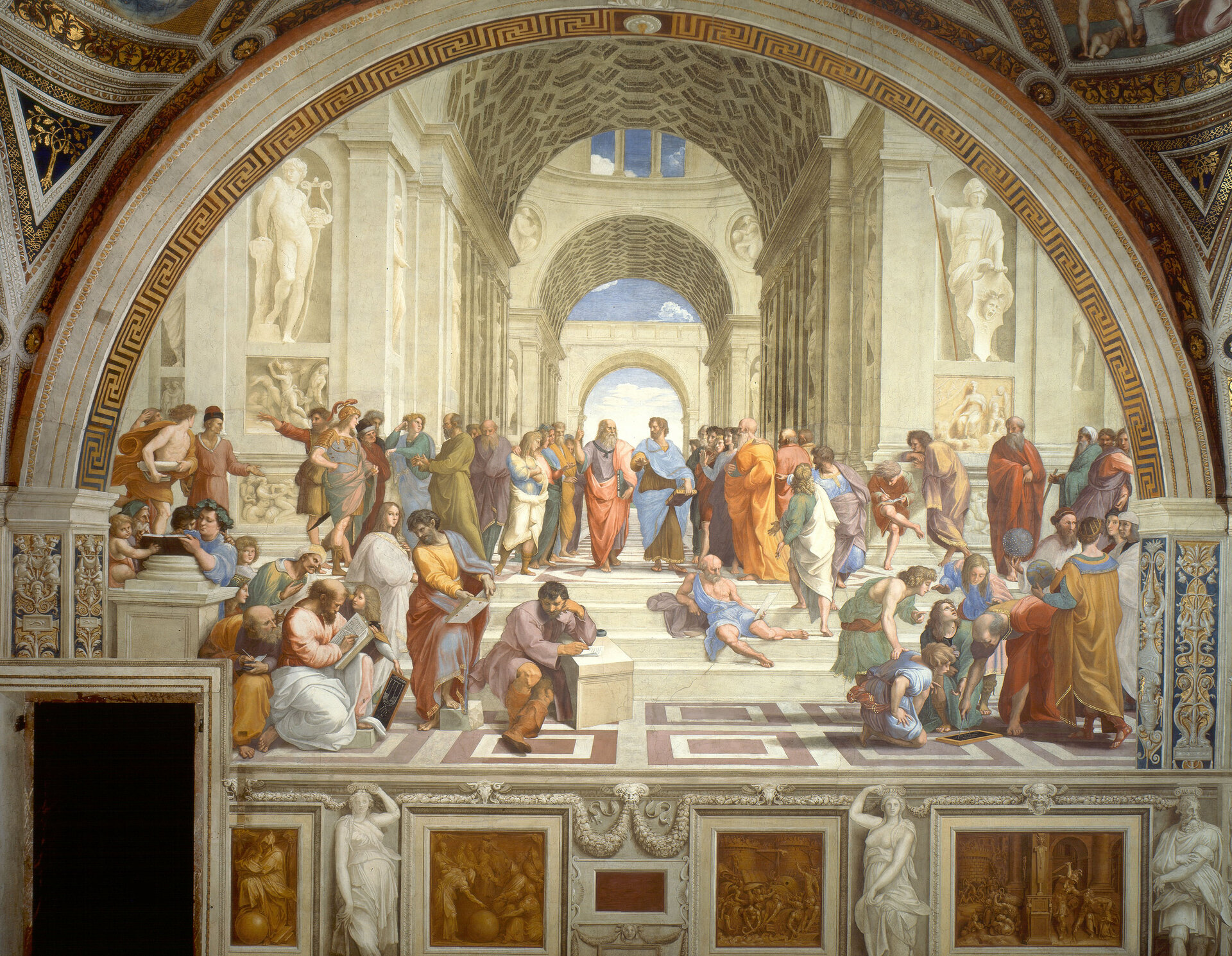
Raphael, The School of Athens (1509–1511). The humanities, made visible.
CS programs have hollowed out the humanities. What general-education requirements remain, high-achieving students place out of with AP tests, so their compositional mastery and their ability to decode human texts is the same at 22 as it was at 17. In hollowing them out, CS programs left their graduates as cogs. By god, if there’s a CS graduate who didn’t get lessons on organizational communication, who didn’t get two units of philosophy, who didn’t get two units of fine arts, they got a glorified vocational degree and they should complain loudly to their deans and chancellors. CS departments: make your undergrads happier, self-driven, questing humanists with history, philosophy, and art. Help them see the bigger picture and its cycles, like the one this post describes. Help them develop taste. Don’t graduate meat proxies whose only job is to drive the machinery of computer science: the agents drive it better now.
MIS programs can borrow the lens of this very post. Undergraduate business has always placed the tactical and the vocational under the umbrella of the human dimension of business. Continue to leverage that as the differentiator. And sell it to nervous parents: technology won’t start the businesses of tomorrow; that will stay human for a while yet. And the humans who harness this amazing technology will be the fastest off the starting blocks.
Footnotes
- The empire that Gayle Laakmann McDowell, author of Cracking the Coding Interview, hath wrought for herself.
- Ironically, in my exit I was told that the key question was around my “judgment.” I say ironic because how to teach judgment to early-career folks has been a lighthouse to me and is now a core competency I possess. It’s also the number one quality that managers worry new hires lack, now that helpful AIs let them skip the inherent turbulence of early-career software development.
- It also seems to be the guiding theory of Anthropic’s execution plan: work really hard on symbolic processing as captured in coding. Trust that getting that one right cascades to many other fields defined by symbolic manipulation.
- One of my most transformative reads was Hesse’s The Glass Bead Game, in which a monkish order of scholars practices an erudite, elite game whereby music can be translated into visual art, and visual art into theorems. I wonder if programming will go the same way: meat-and-potatoes programming will be done by agents, and a rarefied, artisanal programming will be the realm of the last human programmers, performing an aesthetic art for one another, largely removed in relevance and impact from the world of laymen. And yet Hesse’s hero, Joseph Knecht, Magister Ludi himself, ultimately walks away from Castalia, convinced that an order sealed off from the world has grown sterile and cannot last. CS departments, take note.