The Information Density of Old Textbooks
- 7 minutes read - 1464 wordsThere’s a YouTube short making the rounds about how textbooks seem to have been dumbed down:
The upshot of the video seems to be that the venerated classic textbooks of yesteryear — e.g. Thomas’ Calculus and Analytic Geometry; 2nd ed. (~1958) — got to their essential material (e.g. the derivative) much more directly than do the bloated, ridiculously-expensive textbooks of the present moment e.g. Stewart’s Calculus. The elder tome covered the derivative about page 24; the latter finally gets there on page 144.
Being a connoisseur of textbooks, and having even bought several ancient ones for my own personal library, I agree. I’d suggest in addition that the essential difference is that the authors of older textbooks expected their starter ideas, their directional notions, their dashed and incomplete lines — literal master-strokes — on the canvas of the book to be finished as part of the reading of the book by the student. It’s reading as working in the same modality as an apprentice to a guild or a master artisan.
The textbook authors of old left the dehydrated granules of knowledge with an eye-dropper of water. They expected the rest of the bulk to be rehydrated by the sweat of the eager learner’s brow (“Ew, Steven!”).
In an age where attention is fought for against phones; in an age where any resistance or friction summons desk-side genies from the LLM companies, these books are a rebellious, challenging throwback. And they might be a way to get learning back in the classroom.
Examples of my encounters with these elder, information-dense textbooks follow.
Philosophy in 1998
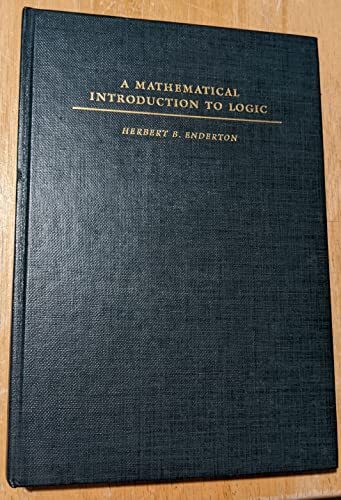
The book that broke me and led me to Hegel. Thanks!
In fall 1998, I returned from a year of study abroad to continue my progress on my degree in philosophy. I had been greatly interested in symbolic logic the Fall before my departure, so on my return, it seemed sensible enough to sign up for Philosophy 344K, “Intermediate Symbolic Logic.”
The catalog copy reads:
…A second-semester course in symbolic logic: formal syntax and semantics, basic metatheory (soundness, completeness, compactness, and the Loewenheim-Skolem theorem), and further topics in logic. Three lecture hours a week for one semester. Prerequisite: Philosophy 313, 313K, or 313Q.
The source book for this course was Herbert Enderton’s A Mathematical Introduction to Logic, first edition, 1972. To my joy, and my budget’s, when I went to purchase it at the university co-op, it was shockingly thin and quarto size. Little did I know that thin, quarto books are to be treated as little venomous serpents: approached only with great caution and great respect.
Opening that book was like opening a book into a universe I had never visited. The psis and existential qualifiers I knew had been replaced with a whole additional symbology of the arcane closer to the alphabet of the angels versus Gottlob Frege.
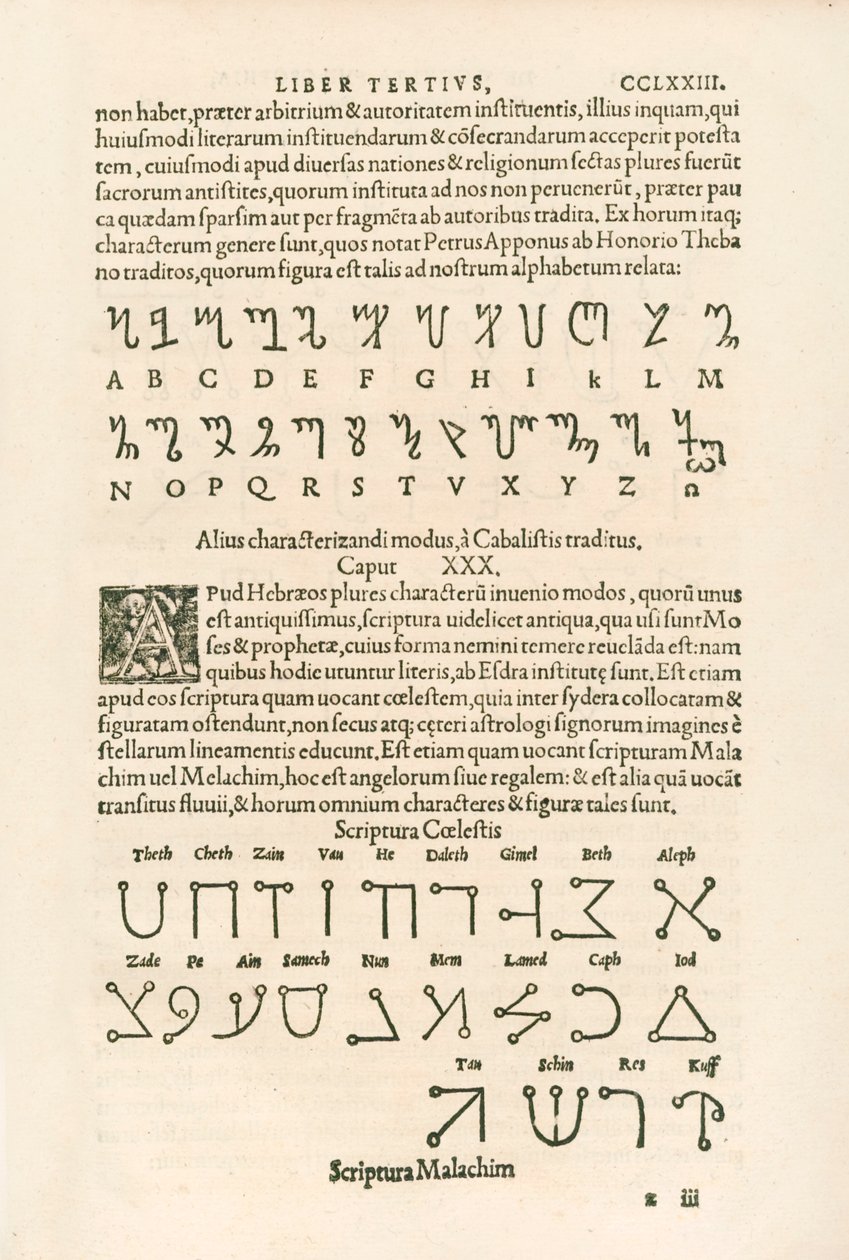
The Theban alphabet: a loose approximation of what I saw in this book
Despite my sincerest efforts, the book (and the course) came to best me. I switched to German Idealism on the last day of the add/drop period and have no regrets.
Logic in 1996
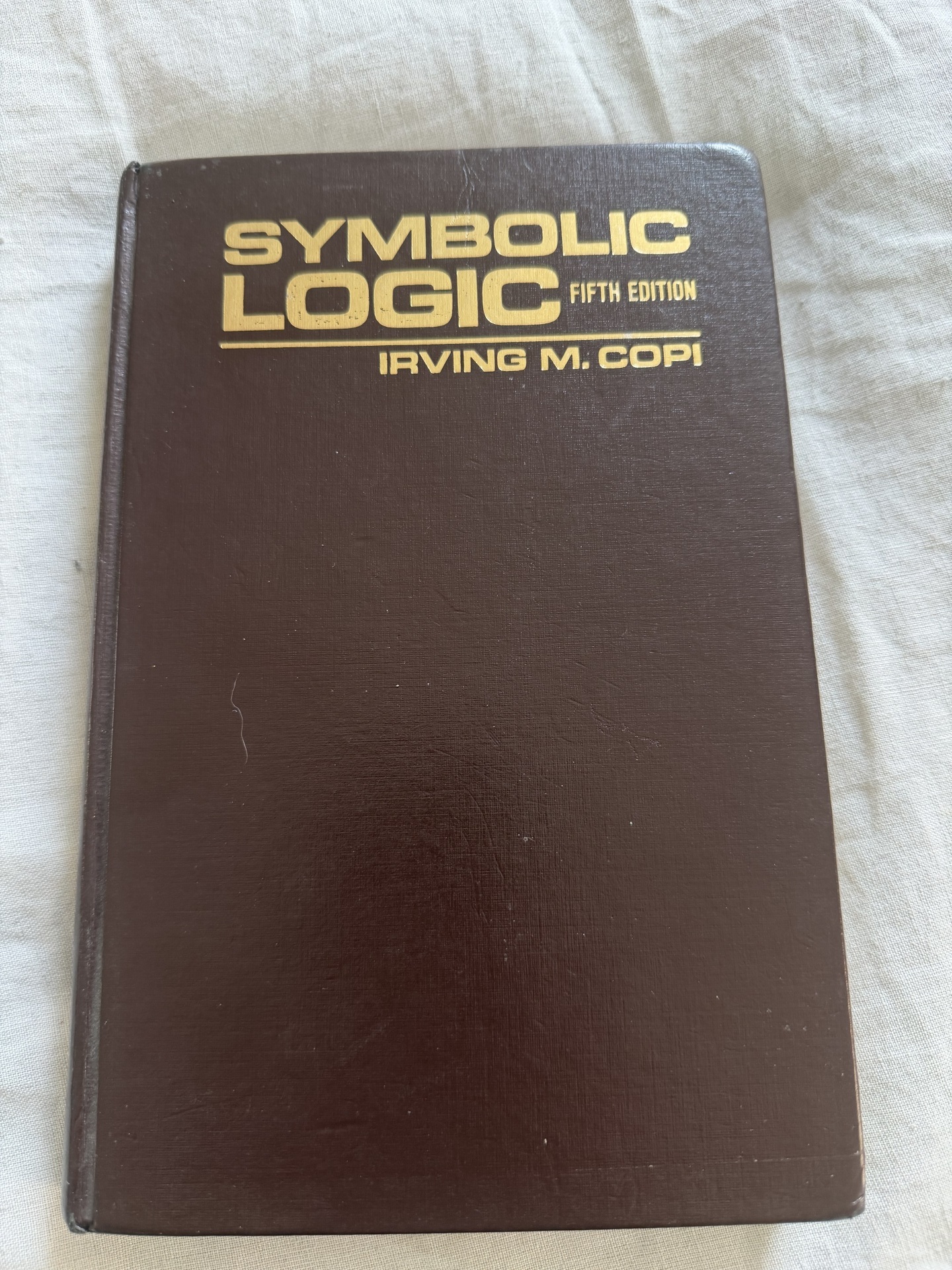
Copi’s beautiful introduction to logic
Speaking of my career as a logician…
My introductory symbolic logic text, written by Irving Copi in 1954, worked similarly, but had entrance ramps to each chapter. On the other hand, I did have the brilliant Tracy Lupher as TA who helped me understand how to unpack Copi’s compressed lesson payloads. It was Lupher who had given me my first tutorial in how to unpack an elder textbook: take the example, work the example alongside, cover the next move, look at the available moves you know, can you apply any, etc. In the end, Copi and I constructed the lesson before I alone had the honor of doing the homework.
The contents were small, intense exercises, there was a quick reference to the fundamental operations of logic on the anterior and posterior covers, but otherwise the student was expected to hydrate the desiccated dust of expertise with the sweat of his own brow (or bitter tears, sometimes both) to render it into something that looks like a modern textbook.
This work is painstaking and requires silence. I took to doing this work in the giant study hall on Friday night when assuredly no one else in the dorm was around. I’d do my proofs and lessons on green engineering paper with a Pilot PhD. pencil. And perhaps most importantly, the Staedtler eraser. For the learning was half as much in the erasing as the penciling.
Latin in 2009
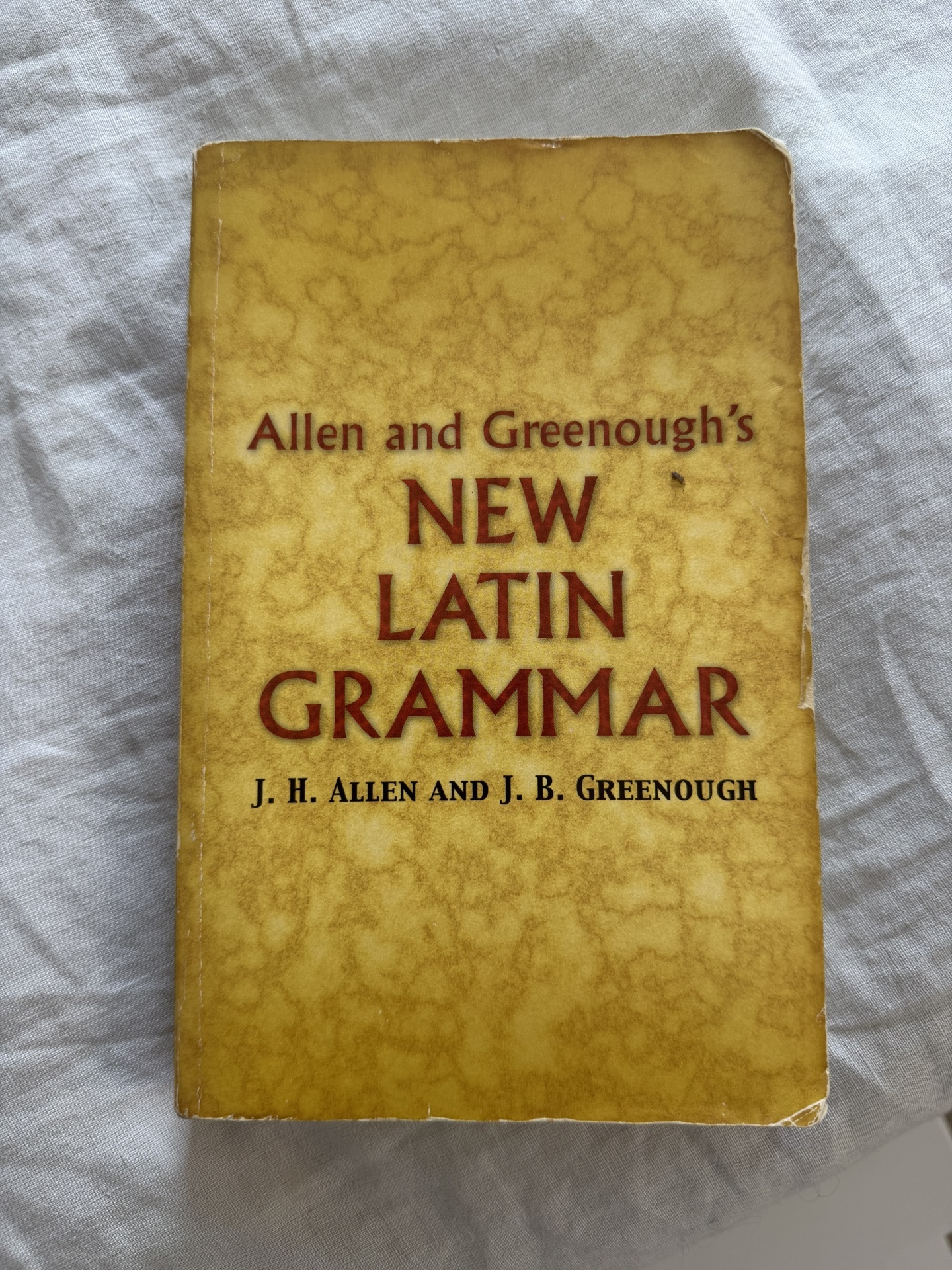
The book where I rediscovered this hydration / Euclidean propositional construction
I saw the same thing in my beloved Latin grammar, Allen and Greenough’s, first published in 1903. Stems and paradigms are given, but the exhaustive enumeration of every conjugation of every verb, every declension of every noun, is not. The student is assumed to find the paradigm and, by their own hand, their own ink, their own paper; they’re expected to extend the lessons themselves into the fully worked-out, hydrated textbook a modern student is simply handed.
Et Al.
And over the years I’ve seen this style of writing in Gregg shorthand; in Reed & Kellogg’s Graded Lessons in English. They all inherit the legacy of Euclid’s Elements as a “construct the guidebook with me” series of first principles that build into learning.
The Modern Textbook
The modern textbook, as the short points out, hands you the graphs, the graphing-calculator exercises, the real-life high-speed photography of birds or plane wings — all of it already yoked to the beautifully inset formula draped atop the problem set.
McGraw-Hill or any of the academic publishers in Midtown East are justifying the bonkers bat-shit insane prices of these textbooks by embroidering the essential core of the topics with whole Oregonian forests’ worth of supplemental material. They’re doing that to suggest value-add synergies and job-ready multi-disciplinary learning modalities. They’re selling hype.
In contrast, these elder textbooks were thin. I suppose unit economics for paper and transportation must have had a hand in these books’ sizes and page counts. They shipped like archive files for computers (zip files, tarballs). The decompression was work left to the reader. A few answers could be given, but the bulk of the material that the student learned from was co-created by the reader. Their notes, their copy books, their graph papers of botched parabolas were as essential to the elder textbook as its cover.
In this way, high expectations blunted the cost of the book by means of the reader’s effort.
In exchange for the student’s co-operation in the construction of the book, learning happens.
Conclusion
I suppose the young commentator, in the new medium — the YouTube short — is noticing what I noticed about 12 years ago: The student isn’t asked to contribute the enrichment of the textbook themselves. I do wonder about the effect of that change — whether it enforces a kind of learned helplessness in students, taught to be ruled by the tyranny of low expectations.
Perhaps the direction forward can and will be slimmer volumes, distributed electronically where learners’ LLM token budgets and/or copy books (or their modern descendants like iPads or Remarkable tablets) are used to hydrate the textbooks into more fully-realized exemplars that the learners can take as foundation for their own studies. This seems better than the back-breaking textbooks of today and who knows — the readers might learn something.
Postscript (2026-07-29)
While reading “In Defense of Difficult Reading”, I came across this closing passage:
The most important literary battle at the moment is not whether Milton or Melville or Morrison belongs on a high school or college syllabus but whether we can preserve the practice of patient reading at all. Professors have lately bemoaned their students’ lost capacity for sustained attention. In high school, reading is too often treated as a skill to master rather than a lifelong habit to instill and inspire. What’s So Great About the Great Books? is a spirited, welcome argument about the value of reading — reading on your own time, with your own appetites and needs, with your desire to make something meaningful of your life after your formal education is behind you. It is an appeal for reading whole books, challenging books, old books, books that have survived scrutiny and even contempt, books that affirm without simplifying, books Kanakia is willing to call “great.”
It’s not just complex mathematics we learn when we can engage with cognitively-demanding, dense texts; it’s complex humanity that emerges in Melville, or Dickens, or Morrison, or David Foster Wallace. If we don’t wish to become machines, we have to stop reading like them and start reading with an eye toward understanding humanity.