TV Shows That Predicted Now, No. 1: The Prisoner, "The General," and AI
- 5 minutes read - 879 wordsEvery day, millions of people ask an AI system a question they don’t know the answer to, receive a fluent and confident response, and move on — having learned nothing except the most dangerous thing possible – the answer.
Patrick McGoohan explained and filmed this dangerous world in the 1967 episode of The Prisoner called The General.
In the episode, what McGoohan warns us against is the risk of answers – even correct ones – sans context. Ultimately for historians, lawyers, and programmers the context is the learning, the correct tokens: words, phrases, citations, syntactically valid code, the epistemic byproduct. If the byproduct becomes the measure of success, then the generated answers are stunningly vacuous, and we shall drown in the mere specious simulacrum of understanding.
Background on The Prisoner
The Prisoner was a single British series of seventeen episodes, written and largely conceived by its star, that redefined what television could be. McGoohan played a British secret agent who, compelled by conscience, abruptly resigns from his post. His employers cannot allow him to resign without an accounting of why. So he is rendered unconscious and imprisoned in the Village: a surreal, creepily postmodern resort community somewhere unspecified, run by rotating authority figures known only as Number Two, in service of an unseen Number One. Our protagonist becomes Number Six. The Village is a psychedelic, psychological labyrinth whose sole goal is to crack the ego, and thus the vault of secrets, of its prisoners.
In “The General,” the wardens of the Village take an unusual tack in their attempt to break Number Six’s resistance. Instead of trying to get Number Six to crack via trickery or drug-laced drinking water, they instead seek to break him by showing that they can use media to make anyone sing their tune. They do this via “Speedlearn” – a TV-based product that offers university level knowledge minus the whole years of work hangover. Simply by watching the avuncular “Professor” for mere seconds, the curious can become the informed.
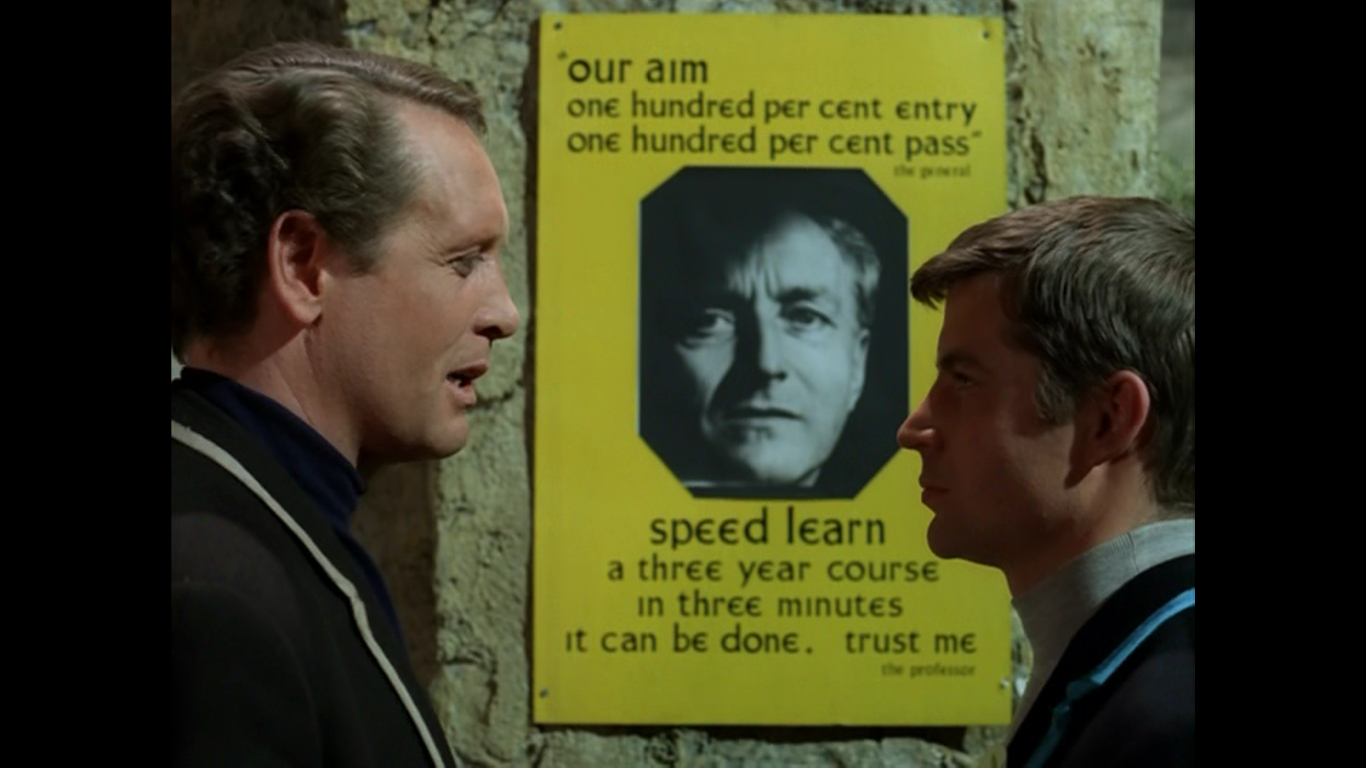
Numbers 6 and 12 discuss ChatGPT’s new campaign
Speedlearn promises great education in fractions of time. It flatters egos: Who wouldn’t want to be better learned? Smarter? More sophisticated? The next day, the Village residents hold forth confidently at cafés and salons about the facts of history.
The catch — and it is a significant one — is that the knowledge arrives without context. The villagers can cite ready dates and facts about European history since Napoleon. But the villagers didn’t choose to learn this material; they did not wrestle with it; they did not do the labor to integrate it. They merely have the correct tokens that match “answer.” While the social performance of education remains intact, the formation that should underlie it has been bypassed entirely.
Sound familiar?
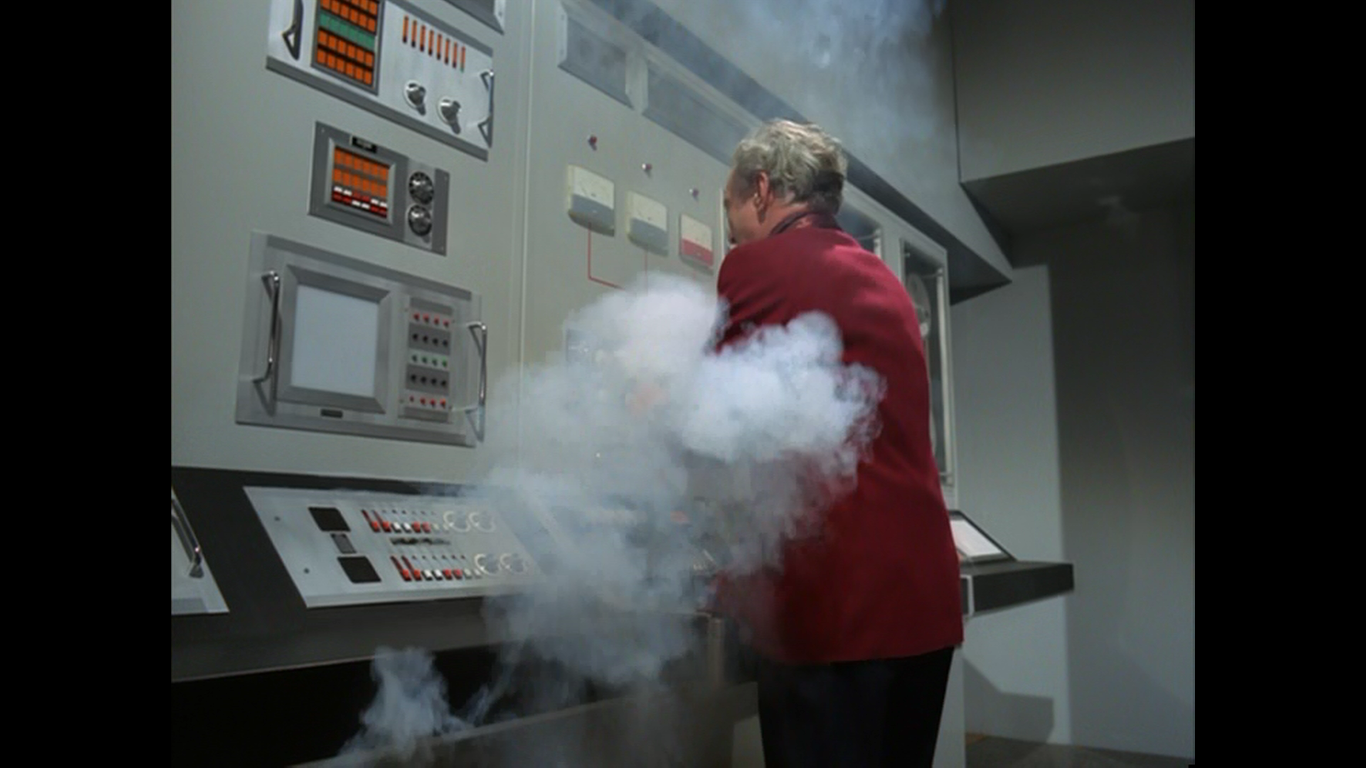
The Professor himself, in an unguarded moment, à la a Cold War defection motif, calls Speedlearn “an abomination” and “slavery.” Ultimately Number Six picks apart the academy supporting the Professor and comes face to face with The General, a fact-inhaling mainframe computer that is building the education/indoctrination program.
You are an expert in Python. Generate me a loop to iterate through…
In true 60’s man-versus-machine spirit, Number Six pulls a Logan’s Run and confronts The General with a question it cannot answer. Which makes it explode. Because Sixties!
McGoohan’s Provocation
I don’t think McGoohan was simply making a Cold War parable about totalitarianism and brainwashing, though the series certainly worked on that level.
I think “The General” is pressing a more pointed question about what happens to the value of learning when learning becomes a delivery mechanism for indoctrination to a point of view…or a manner of work. And here it loops back to the present AI moment.
As we work with AI systems we have to make sure that we commit and preserve the incidental steps toward “Eureka” as well as “Eureka” itself. Archimedes didn’t discover buoyancy simply because he sat in the bath: he had wrestled with the question for days and weeks priming his neurons to be ready for the “Ah-hah!” synapse leap.
In my own practice, I’ve taken to adding a doc directory where I curate the
conversations, where I summarize the facts, where I prime the “general”
knowledge that I had groomed over days of looking at a codebase. It’s also,
frankly, more cost-effective: since AIs forget between sessions, grooming the
right context burns through my usage budget: on-disk artifacts can remind me as
well as prime my AI assistants.
As Naur wrote in Programming as Theory Building, and as David Hogg has argued for astrophysics in “Why do we do astrophysics?” – the durable part of any intellectual practice is the theory its practitioners build, not the tokens they produce. If the goal of programming with AI is code that compiles and runs but leaves the theory of the program as an ephemeral computational puff whose debuggability, maintainability, and comprehensibility are ignorable provided it Does the Thing in the short term, then we have made The General’s bargain without even noticing.
McGoohan thought The General’s world would be a dystopia administered by shadowy government wardens in a picturesque Welsh village. Turns out we built the Village’s indoctrinating machinery ourselves, called it productivity, and made it available as a subscription.