The Enduring Songwriting Genius of Harry Chapin and "W.O.L.D."
- 14 minutes read - 2817 wordsAs an elder millennial, I grew up in the ambient wash of 70s folk and singer-songwriter rock. Across the shag-carpeted living rooms of my childhood memory, I can see lightly sun-bleached album covers — Carole King’s Tapestry, James Taylor’s Sweet Baby James, Jim Croce, Cat Stevens. My generation grew up downstream from people who knew how to craft a lyric and place a capo.
While I admire all that cohort, it was Harry Chapin who made the biggest impact on me. I rediscovered him late in high school courtesy of a creative writing class, but I was made a fan after a late-afternoon dash to Houston’s Galleria district. And his words have stuck with me for decades now. But the other night, while doing dishes, I was served up his “W.O.L.D.” and this time I heard something different. Tutored by life and the voice people use to lie to themselves, I heard a truly different song. And with that, I was in love with Harry’s (RIP) talent all over again.
The Giant Cat (in the Cradle) in the Room
Chapin scored one of the titanic hits of the era with “Cat’s in the Cradle.” It’s unavoidable. It was a poem written by his wife that he apparently didn’t think much of. But when he turned it into a song, it was a success.
In my own teens it was curiously covered by the band Ugly Kid Joe who had an inflatable sex doll in the preceding video. The world is strange. Regardless, I think this speaks to the timeless war that exists in the hearts of lots of dads as they pull out of suburban driveways and go: how to balance our capitalist overlord’s commands, our need to provide for our families, and our children’s simple request for the most precious asset of all: time.
It’s ostensibly a song that “When you’re a parent you’ll understand.” But, and here’s part of the genius, everyone understands this song. A man has snapshots with his precious son (Oh how my heart aches now to think of my precious son, now) where he never has time for nursery rhymes or catch and, all too soon, the time is gone. Chapin spares nothing with the turn line:
As I hung up the phone it occurred to me, he’d grown up, just like me. My boy was just like me.
I of course heard that song on oldies format radio or on the radio at the dentist’s office. It was a bit maudlin, but it was always earnest. It was no surprise to me when I’d see that it was included on TV-marketed “Greatest Hits of an Era” compilations (“on 4 LPs or 8 cassettes”).
The William Henry Porter (O. Henry) of It
Sometime around sixth grade I was introduced to the master of the twist ending, “O. Henry.” Most will be familiar with his “Gift of the Magi.” A resident of Texas (Austin, of course) during his peripatetic life, Henry was that rare non-Texan voice that still made it through the Texas educational gantlet to fit into our core reading obligations.
If anyone had transmuted the twist ending – or the emotional burro kick to the solar plexus – that O. Henry is admired for into song, it was Harry Chapin. Sitting in Reading class I remember thinking, “Twist endings are kinda like ‘Cats in the Cradle.’”
Meeting Harry as a Teen
I was pursuing entry into university. My schedule included AP classes as well as a creative writing class. On some Fall day in 1994, I needed to head to uptown Houston for an appointment. I did the 290 to 610 path after school; did the appointment; and then headed back. During that time, the heavens had opened up and we were getting a true Houston downpour.
It was oddly timed as far as the weather goes: it’s a humid thunderstorm outside; yet getting drenched will make you cold. On the other hand, inside the car with the AC on you catch a chill. But if you turn the AC off, you start to sweat. Houston weather is strange. As I and a few hundred other commuters headed back to the suburbs, I SEEK’d across the FM dial. I landed on twinkling steel-string guitar finger-picking and stopped to listen.
It was raining hard in ‘Frisco
I needed one more fare to make my night…
I guess the DJ was probably looking out of their suite’s windows somewhere in the Galleria (this is when radio stations were not nationally syndicated; Houston radio was made in Houston) and decided to cue up Harry Chapin’s “Taxi.”
I was old enough and had enough musical ear to guess — probably — that it was the “Cat’s in the Cradle” guy. I let the song play. I listened to his accent; I figured it was Boston (vaguely English, or perhaps in an aping style of the mid-Atlantic diction?). It would turn out to be Long Island, NY.
I had been in love with San Francisco since I’d visited some five years before. So a story set there between a modest hack and a glamorous star who knew each other back-when intrigued me. As the throaty cello shook my speakers, I heard that their relationship back when was gentle, sexual, and long-forgotten. Those tender teens once had dreams; he, to fly; her to act. As the hack’s dream, the star’s remembrance, and my sympathetic reverie ended as the star reached her home at “six-teen Park-side Lane” I knew I had been transported.
But the music wasn’t fading. I dreaded that the twist was coming. She’d gotten her dream. He hadn’t.
Here she’s acting happy inside her handsome home And me, I’m flying in my taxi, taking tips and getting stoned.
Oh the brutal parallelism of the gerunds took the dreams of teens, “See, she was gonna be an actress; and I was gonna learn to fly” and lopped off the verb (act/fly) and added “ing” and left us with the bitter verbal nouns of disappointment. The actress is acting happy and the flyer is flying on chemicals. The gut punch of modest dreams on mortgage hit like it always does.
The structure, the formalism, the vocabulary, the plaintive simplicity worthy of Edgar Lee Masters. I was baptized a fan.
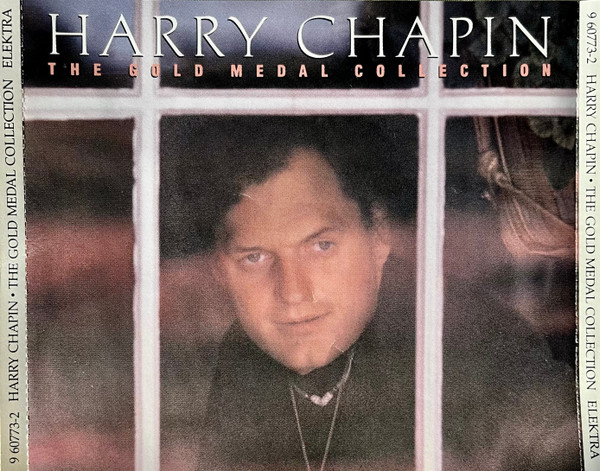
The Gold Medal Collection — a monster double-CD set for a prolific writer and hard worker
I bought the Gold Medal Collection — two CDs — and marveled at the breadth of Harry’s songwriting. But a great many of my favorite songs were the stories of humble people with modest dreams who didn’t quite get what they were after. Or who got it, with a bitter cherry on top.
I went back to my creative writing instructor who had, a few days or weeks earlier, played us “Cats in the Cradle,” and told her that I’d discovered “Taxi” and I was hooked. She smiled. She knew. They always know.
I’m told music critics found him tacky or pedestrian, preachy and naive. He was. It’s said arrangements were unsophisticated — don’t care. Not everyone is the Velvet Underground or David Byrne. Critics vanish up their own asses too much.
“W.O.L.D.”
I tell this story, I suppose for nostalgia, but also because I want to document that I heard a lot of Chapin back as a teen. I was still a regular listener in my early years of college and, in some part, his penchant for stories or glittery barbs of sorrow led me to “No Depression” alt-country music and that Austin sound.
“W.O.L.D.” seemed like another example of modest lives silently struggling against a cold world (very much like “Mr. Tanner”)1. To my teen and young ear, it was the story of a man who loved music very much and who, lacking the talent for performance, became the performer of eager fandom, a disc jockey. And the song works that way. It’s a fine song.
But a few days ago, as I washed dishes, I realized that Harry had had a different trick up his sleeve. A true songwriting master, he’d left a time-bomb inside “W.O.L.D.” that detonates for the mature ear: the ear that knows relationships, and bitterness, and disappointment, and parenthood, and marriage, and tenderness. This is emblematic of Harry’s greatness. His songs teach you again when you’re ready to learn something new.
“W.O.L.D.” is written firmly in the voice of a toxic narcissist who’s out to gaslight both himself and his (presumably ex-) wife. Having my days filled with a performative narcissist had my ears and eyes tuned to hear and see the post hoc rationalizations in the song and now I love it even more.
W.O.L.D. — Harry Chapin (lyrics)
Hello, honey, it's me
What did you think when you heard me back on the radio?
What did the kids say when they knew
It was their long-lost daddy-o?
Remember how we listened to the radio
And I said, "That's the place to be"?
And how I got the job as an FM jock
The day you married me?
It was two kids and I was into AM rock
But I just had to run around
It's been eight years since I left you, babe
Let me tell you 'bout what's gone down

[Chorus]
I am the morning DJ at WOLD-D-D-D-D-D-D-D (O.L.D.)
Playing all the hits for you
Wherever you may be
The bright good morning voice
Who's heard but never seen
Feeling all of forty-five going on fifteen

[Verse 2]
The drinking I did on my last big gig
It made my voice go low
They said that they like the young sounds
(Sounds, sounds, sounds)
When they let me go
So I drifted on down to Tulsa, Oklahoma
To do me a late-night talk show
Now I've worked my way down home again
Here to Boise, Idaho
That's how this business goes

[Chorus]
I am the morning DJ at WOLD-D-D-D-D-D-D-D (O.L.D.)
Playing all the hits for you
Wherever you may be
The bright good morning voice
Who's heard but never seen
Feeling all of forty-five going on fifteen

[Bridge]
I'm making extra money doing high school sock hops
I'm the big-time guest emcee
You should hear me talking to the little children
And listen what they say to me
I got a spot on the top of my head
Just begging for a new toupee
There's a tire around my gut from sitting on my [butt]
But it's never gonna go away

[Verse 3]
Sometimes I get this crazy dream
That I just take off in my car
But you can travel on ten thousand miles
And still stay where you are
Thinking that I should stop disc jocking
And start that record store
Maybe I could settle down
If you'd take me back once more


[Verse 4]
Okay, honey I see
I guess he's better than me
Sure, old girl, I understand
You don't have to worry, I'm such a happy man

[Pre-Chorus]
(WOLD)
(WOLD)
(WOL)
(WOLD)

[Chorus]
I am the morning DJ at WOLD-D-D-D-D-D-D-D (O.L.D.)
Playing all the hits for you
Wherever you may be
The bright good morning voice
Who's heard but never seen
Feeling all of forty-five going on fifteen

[Outro]
I am the morning DJ at WOLD-D-D-D-D-D-D-D (O.L.D.)
WOLD (O.L.D.) D-D-D-D-D-D-D (O.L.D.)
WOLD-D-D-D-D-D-D-D (O.L.D.)
WOLD (O.L.D.) D-D-D-D-D-D-D (O.L.D.)
WOLD-D-D-D-D-D-D-D (O.L.D.)
WOLD (O.L.D.) D-D-D-D-D-D-D (O.L.D.)
WOLD
The DJ says “Hello honey, it’s me.” For the pre-cell phone generation, this is a pregnant sentence. First, it communicates that the listener and the speaker are so long acquainted that the speaker can assume his voice is recognized. And there’s a cutting subtlety, the narcissist DJ assumes everyone recognizes his voice. This point of view will be borne out in the next several minutes. One line in and Harry’s telling two stories.
The DJ then asks “What did you think when you heard me back on the radio? / What did the kids say when they knew / It was their long-lost daddy-o?” No kid asks that. It confirms that we’re firmly in self-serving delusion. It imagines young tots asking where Daddy is and Mom soothing their abandonment with stories about the magic of radio. The DJ has centered himself at the root of their lives while being flagrantly non-present in it. The theme of the questions of children will loop back later. And what child missing their father is focused on his career? Did he not hear “Cat’s in the Cradle?”
The lyrical choices are clever because in several places the narrator — like all narcissists — explains how he didn’t really have any choice but to do what was damaging to his family. For his career. For recognition. It wasn’t his choice to abandon them:
Here to Boise, Idaho
That’s how this business goes
By the time we hit the bridge, I was frankly agog for the poor woman who was having to hear this well-worn, self-serving spiel, like a ‘45 played a few dozen times too many.
My experience turned visual. I was no longer parsing cleverness in the words, but seeing a movie. The poor lady had had to suck up her abandonment and survive her neglect. She’d been forced to raise two kids herself. She watched her girl dreams of marriage and home with the DJ slowly fall apart like a sand castle rapaciously disassembling fantasies with each wave. Perhaps in her heart she encounters the ghost of their early love when he “… got the job as an FM jock / The day you married me?” I can see the revulsion and sadness and mourning in her face as she leans against the wall in the kitchen next to the wall-mounted phone with the long corkscrew cord and lets a silent tear or two drop as the narcissistic DJ rattles on. He tries her patience; he tries all the patience in the universe, because his ego is yet bigger.
Maybe she comes back out of that reverie to hear of the balding, paunchy fellow who’s celebrating his making extra cash DJing sock hops. As he drops the line “You should hear me talking to the little children / And listen what they say to me” I can imagine her wistful sadness turning to a red hot coil of wire. Little children? Strangers’ little children asking you questions. Well, buddy, I’ve got two children with your eyes and their questions are Where are you and your blind pursuit of being a fucking disc jockey doesn’t soothe their tears, doesn’t nurse them when sick, doesn’t mend my broken heart when you abandoned me for the sound of your own voice you asshole.
She stifles the rage and chokes on a sob. Her new husband brings water and pats her shoulder. He mouths the DJ’s name. The running mascara and a nod confirm it. He’s been through this before. He silently sits at a wooden chair.
Smiling and snickering through his cluelessness, she doesn’t have time for this phone call of delusion which has freshly poured lemon juice in the wounds of her paper-cut sliced heart as he proposes:
Thinking that I should stop disc jocking
And start that record store
Maybe I could settle down
If you’d take me back once more
It’s time to close this canal ride through misery up. She tells him that that’s not possible. Her new man and the stability she and he are providing the children now won’t suffer his boyish flights of fancy. Like every thwarted narcissist, he pulls the last weapon he can find: emotional skewering with a guilt-trip.
Okay, honey I see
I guess he’s better than me
Sure, old girl, I understand
You don’t have to worry, I’m such a happy man
Because again, it’s all. about. him. Isn’t it?
The emotionally developed listener laughs — because it’s ridiculous; he’s ridiculous. And in other eras, it was bad farce. But then we’ve lived through an era where a narcissist was visibly comforted by winning a peace prize…from FIFA when “snubbed” by the Nobel committee.2
Conclusion
I’m so thankful for the heaps of music Harry left before he left this world all-too-soon in 1981. I can’t imagine that the Reaganite hedonism of early ’80s music would have been comfortable for him, but his idealism is something that this very cynical world around me today could use. But he engineered his music well. He hid subtle facets where only those who have lived life’s vicissitudes could see them. That is, he made it timeless.
-
On side two of the same album as “W.O.L.D.,” Mr. Tanner tells of a Midwestern dry cleaner who dreams of singing in New York: “Music was his life. / It was not his livelihood. / And it made him feel so happy / And it made him feel so good…He did not not know how well he sang. / It just made him whole. ↩︎
-
https://apnews.com/article/trump-world-cup-fifa-peace-prize-e14f95b8adaa197c869cad407b6ef604 ↩︎