
"Sinners" the Movie and the Dreamed-of Tabletop RPG
There’s a movie that’s sat rent-free in my head for almost a year and half, and that’s pretty rare. It was Ryan Coogler’s film, “Sinners.” Two things have stuck with me about it.
- It’s a Black movie. There’s a whole culture not native to my own that Coogler shared with the world. It’s a culture removed by racial difference and also time to my experience. These are someone else’s grandparents' stories. And I’m so thankful to have learned more. But the film is also in conversation with some of the academic/literary learnings I have: Br’er Rabbit as an avatar of “Rabbit,” an African folk trickster known for his wiles; the power of haint blue; the food magic of gumbo.
- I remain convinced that the “Sinners” universe would be one of the best tabletop RPG (character sheets and funny dice) or card-and-token games ever.
Our friend Ryan wrote his own take on the film over at Signal Watch, worth a read alongside.
The Computer-Forward Cyberpunk Icons of Eurythmics
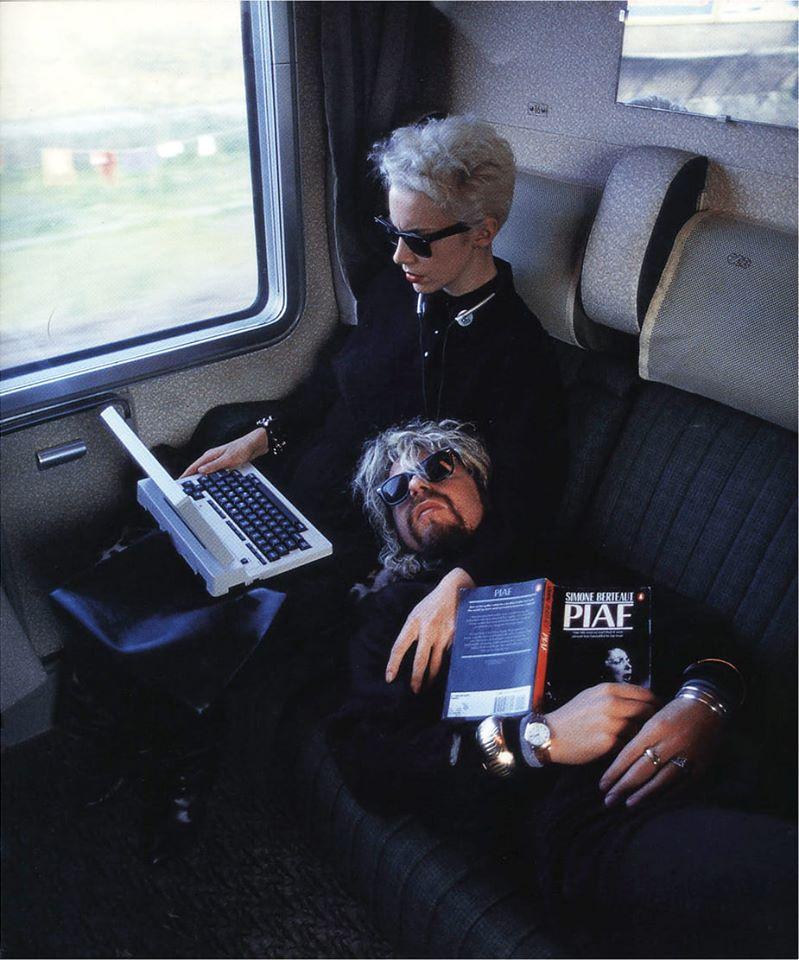
Annie Lennox and Dave Stewart on a train in 1986, Stewart working a Tandy 200.
Look at these cyberpunk heroes. He’s collapsed after the time-tunnel brought them back to this era, reading one of these “books” that he read about on his PersoComp in school. Here, in the 20th century, he’s going to read about an artist he heard about in a holofilm once. She remains focused on the mission and is using this century’s primitive PersoComp – in this era they call it a Tandy 200 – to determine details about her assassination target in BASIC.
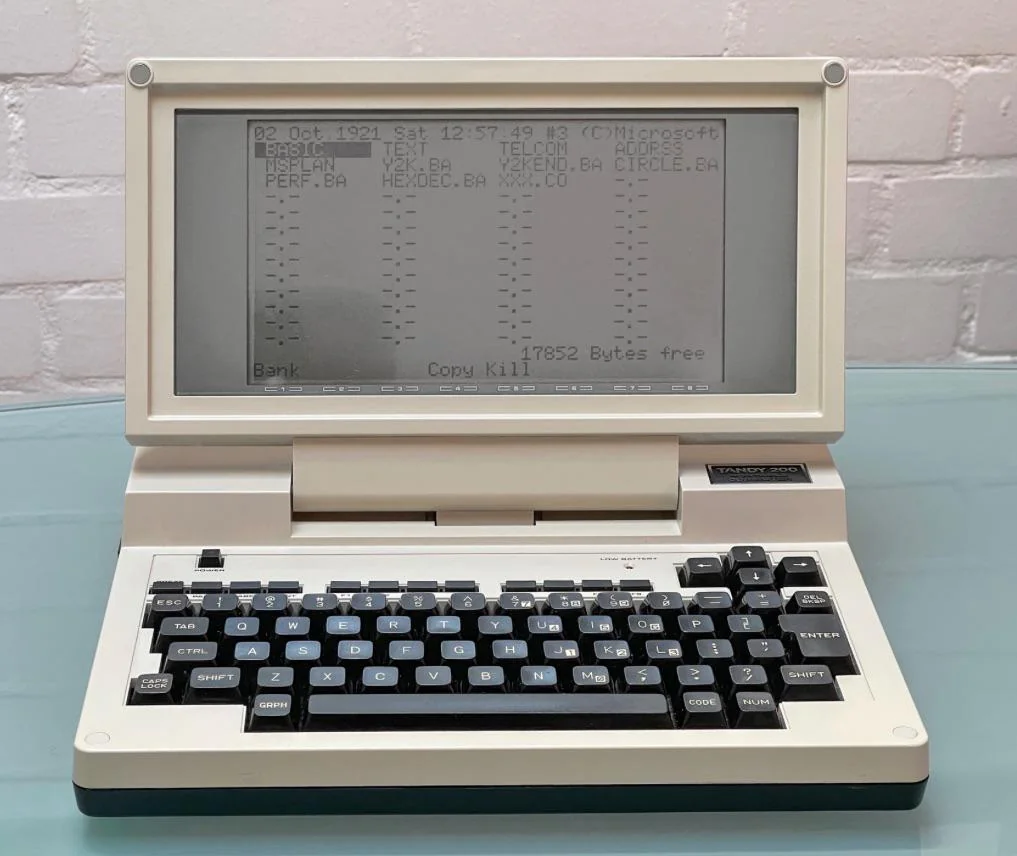
The Tandy 200, ready for its close-up.
In all seriousness, in Reagan/Thatcher 1986 she’s programming (synthesizer timings?) or taking notes while riding on a train. He’s mirrorshaded-out like a William Gibson assassin.
There’s really not much else I can add to how awesome Eurythmics were and still are. Catching their videos (or Bowie’s or Prince’s) back then was like seeing a show at MoMa or Cooper-Hewitt or the Whitney tunneled 50 years backward in time to early MTV. I wasn’t sure I liked it, but I knew, even then, that it was art. Just listen to those adversarially timed hand-programmed synthesizers in some sort of technological dialectic with modernity itself at the opening of “Sweet Dreams.”

Steve Jobs in Exile
I’m not a Steve Jobs fanboy.
Yes, I loved OSX in its early days. Yes, I rocked a PowerBook my first 3 years of college. Yes, I loved my iPods, my iPads, and my iPhones. The man cast a notable shadow into the technical world we inhabit today.
But I don’t idolize the man. He had few, if any, true friends. He made horrible choices about parenting and how to spend his time. He was mercurial and cruel. I don’t idolize that. But I do care very much about the engineering that happened under his leadership.
- Not Steve’s Apple, but Woz’s lovingly hand-wrapped wiring on the first Apple board
- Not Steve’s Macintosh, but the painting, the icons, and later the HyperCard-bearing Macintosh of Bill Atkinson
- Not Steve’s NeXT, but Avie Tevanian’s Mach microkernel and OOP-rooted primitives for building and scaling complex software
In short, I want to hear more about the engineering decisions, the financial trade-offs, the arguments, the insights, the gem of an idea at a research park or university that was bought and became the basis for the products we love.
Unfortunately, Cain’s book doesn’t deliver that. What it does deliver however is a very good plug to the NeXT-era lacuna in Walter Isaacson’s book (which Isaacson failed to cover in adequate length). And I thoroughly agree with Cain: you can’t understand Jobs’ return to Apple without understanding his NeXT fallow period. To my mind, the fact that Isaacson gave such short shrift to the topic suggests that he was bored of the journalism task of Jobs’ biography and was getting swept up in his subject’s own reality distortion field (or, uncharitably, it was the beginning of his falling in love with his subjects and confusing access journalism for journalism).
Regardless, what I want, what I really, really want is the engineering biography of the NeXT workstation and the NeXTSTEP OS. Having read this book, I shall continue to wait. However, if you’re interested in what Steve was like as he left Apple (cruel and profligate and immune to negative feedback), this book is for you. If you’re looking for how to abuse the spirit of non-competes, here’s a guide. And if you’re wondering how the Mac became the premiere development platform for the last 20 years among (self-identified) cool developers (“Unix weenies by Armani”), this is a great start.